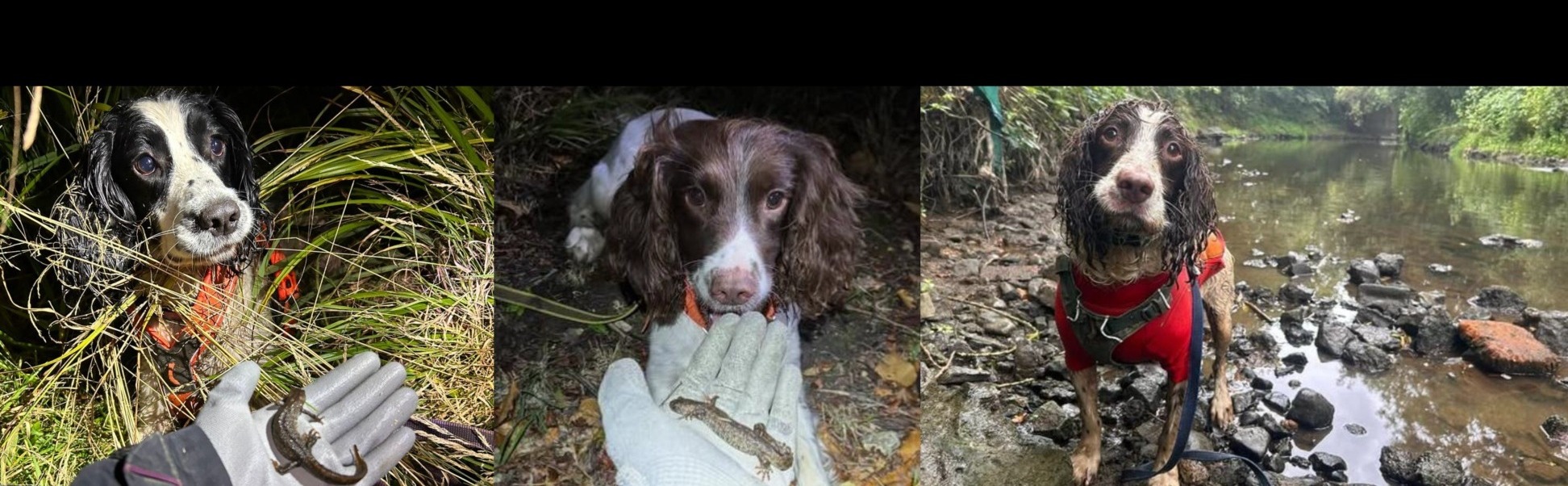
Leo was specifically selected to become a conservation detection dog due to his lack of predatory drive. Leo has undergone testing to ensure he has no desire to chase any wildlife or livestock.
Leo is also always kept on a lead during surveys to minimise the disturbance to nearby wildlife and is calmly rewarded with a ball when he finds any field signs.
In sensitive habitats, detection dog surveys often cause less disturbance than traditional methods as detection dog surveys require less vegetation trampling / clearance. The surveys are also conducted more quickly than traditional methods, reducing the time spent in sensitive habitats.
From our discussions with Natural England, they are willing to accept data collected by detection dogs on mitigation licence applications providing the relevant survey guidelines are still followed, i.e. for water vole surveys, two surveys should be conducted between mid-April to end of June, and July-September.
We have had planning applications approved and conditions discharged using conservation detection dogs as the survey methodology.
We are happy to provide documentation and evidence to support proposals when applying for works in designated sites.
Leo is trained using positive reinforcement methods. Leo’s reward is a ball.
Similar to how explosives dogs are trained, Leo was initially trained to have a calm and passive response to a neutral odour, before introducing droppings/spraint. This is important, particularly around burrows, as to not disturb any water voles that may be present inside.
Welfare is our top priority when conducting surveys, for both our canine colleagues and our target species. As trained ecologists we are experienced in conducting traditional survey methods for the target species.
We ensure our canine colleagues remain happy and healthy. Leo lives at home in the countryside with Audrey, where you will usually find him curled up on the sofa or playing with his toys.
We have a strict working directive: no more than 5-6 hours a day of ‘harness time’ and a limit of three days in a row. This is adjusted during periods of hot weather or very difficult terrain. Within these times, regular breaks are undertaken which also ensures our survey efficiency and accuracy of the search doesn’t drop.
Whilst a dog can usually access hard-to-reach areas, such as dense vegetation, there may still be areas that may not be appropriate for a dog to access for welfare reasons, such as large stands of nettle or brambles.
It may also be useful to assess if a boat survey may be more appropriate, as this can be pushed into sections of the bank which could be completely inaccessible by land. Morph Ecological Consultants has a kayak which can be used to survey from the water.